How AI Browsers Are Reshaping Search and Information Discovery

Not long ago, research meant opening Google, clicking through a dozen links, and hoping one of them had the answer. Today, AI browsers do that work for you. You ask a question, and they return a complete, synthesized explanation in seconds. What seems like a small upgrade actually signals a major shift. We’re no longer just searching for information, we’re expecting instant understanding.
That change says a lot about where technology is heading and how our behaviour is evolving with it.
So where does that leave us? To make sense of what’s happening, this blog looks at what AI browsers are, how they differ from traditional search, the risks and opportunities behind them, and how they’re reshaping the way people and businesses discover information online.
Table of Content
- What is an AI browser?
- AI search vs traditional search: What’s changing?
- The future of how we find information
- Security, privacy, and bias in AI search
- What AI browsers mean for SureSwift and private equity
- Using AI responsibly
What is an AI browser?

An AI browser is the next evolution of how we navigate information online. Instead of giving you a list of links to sort through, it uses large language models (LLMs) to interpret your question, search the web, filter what’s relevant, and return a synthesized answer on the spot. It’s built around understanding, not indexing.
Unlike traditional search engines that rely on keywords, AI browsers understand natural language and the intent behind a question. When you ask something, the model parses the meaning, pulls from trusted sources, and generates a clear, conversational response. The experience feels less like searching and more like talking to someone who already read the internet for you.
Tools like Perplexity, Arc Search, and Microsoft Copilot demonstrate this shift in real time. Ask them, “What are the key trends in local service businesses?” or “Which CRM is best for a small team?” and you’ll get a concise, citation-backed summary. Some tools provide direct sources for transparency and others aim for a seamless Q&A experience. Behind the scenes, these tools are constantly crawling, filtering, and interpreting new information to give you context-rich answers in seconds.
AI search vs traditional search: What’s changing?
The way we search is shifting from static to interactive. Traditional search engines are built around keywords. Type a few words into Google, hit enter, and scroll through a list of links ranked by relevance. It’s a process that forces you to think like an algorithm, breaking your question into searchable chunks.
AI browsers work in a completely different way. Instead of keyword matching, they respond to full questions written the way people naturally speak. You’re no longer crafting a query—you’re starting a conversation.
And that conversation evolves. Unlike traditional search, which resets with every new query, AI browsers remember context. You can ask follow-ups, refine your question, or explore a tangent without starting over. Instead of ten tabs and ten articles, you get one synthesized explanation, often with sources attached. It’s the difference between being handed a reading list and being given a thoughtful summary.
But there’s a trade-off. AI models are powerful, not perfect. They rely on large language models trained on vast and sometimes uneven data, meaning the accuracy of an answer can vary. In fact, more than 60% of answers given by AI browsers are incorrect. That’s often due to misinterpreting information, pulling from outdated sources, or generating responses that sound confident but aren’t fully accurate. Some tools cite their sources; others don’t. The experience feels seamless, but human judgment still matters, especially when decisions rely on precision.
The future of how we find information

It’s still early, but one thing feels certain: AI browsers aren’t going away. Whether they eventually replace traditional search engines, integrate with them, or evolve into something entirely new, they’re already reshaping how we discover information online.
The shift won’t happen all at once. For a while, we’ll likely live in a hybrid world where traditional search and AI assistants work side by side. But people will keep gravitating toward tools that reason, summarize, and contextualize. The experience is simply too efficient and too intuitive to go backward.
For businesses, this creates a new kind of visibility challenge. Ranking on Google used to be the goal. But now that we are in an AI-first world, the question becomes: Can an AI model understand your business well enough to surface it in an answer?
A website optimized for keywords won’t be enough anymore. To stay discoverable, companies need content that’s structured, factual, and easy for algorithms to interpret. That means clear messaging, data-backed insights, consistent language, and content that teaches rather than sells.
This is why many companies are now creating AI-readable content: summaries, FAQs, structured explanations, product breakdowns, and data points designed to help LLMs understand what they do. Instead of chasing clicks, they’re building clarity—and clarity is what gets surfaced, cited, and shared in this new era of search.
Security, privacy, and bias in AI search
AI browsers open the door to faster research and sharper insights, but they also come with growing concerns about their reliability, security, and ethical implications. As these tools become part of everyday workflows, we must be aware of their potential risks. Conversation must now consider how issues like prompt manipulation, data privacy, and intellectual property shape both user trust and the credibility of AI-driven insights.
Prompt injection and manipulation
AI browsers introduce a new kind of vulnerability: prompt injection. It happens when hidden text or code is embedded in web content to influence how an AI interprets or summarizes information. These attacks can override an AI’s internal safeguards, prompting it to misreport information, disclose sensitive data, or produce biased summaries.
A page that looks harmless to a human might contain hidden code that instructs the model to, for example, favour a company’s stock, distort due diligence summaries, or omit key financial risks. For people using AI tools to make decisions, especially in research-heavy fields, this creates a real uncertainty: how much of the output is insight, and how much is subtle manipulation?
Privacy and data retention
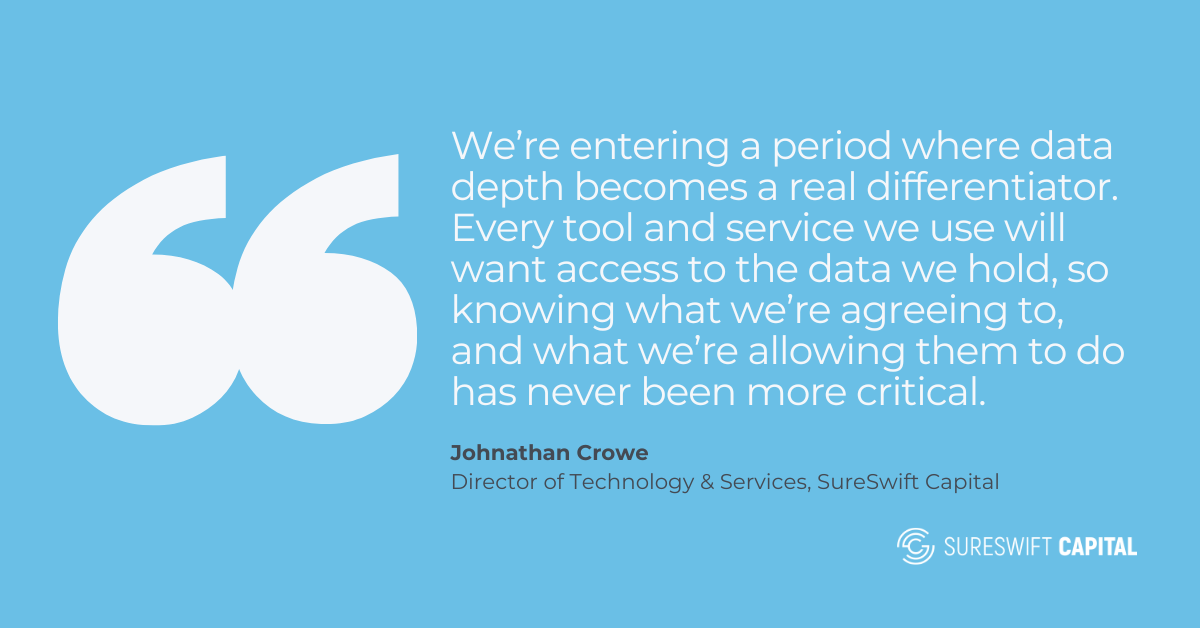
Most people don’t realize how much information they share when using AI browsers. These tools don’t just process a question, they often capture the follow-up prompts, browsing patterns, and sometimes even identifiers tied to your account. And without clear disclosure, it’s hard to know how much of that interaction data is stored, analyzed, or used to train future models.
This raises real concerns about data privacy and competitive intelligence, especially in private equity or M&A where sensitive deal discussions could inadvertently feed into large-scale models. The issue here isn’t that AI “sees too much”, it’s that users don’t always know what it keeps. Transparency in data handling will determine whether AI browsing becomes a trusted research tool or a privacy liability.
Intellectual property and bias
AI summarization blurs the existing boundaries around intellectual property and content ownership. When an AI tool rewrites or condenses original material, it can unintentionally repackage someone’s work without attribution, raising questions about fair use and originality. At the same time, models inherently reflect the biases in their training data, potentially amplifying stereotypes or underrepresenting niche viewpoints.
What AI browsers mean for SureSwift and private equity
These concerns, ranging from manipulation and privacy exposure to intellectual property and bias, highlight that AI browsers aren’t just another tool. They reshape how information is gathered, interpreted, and trusted. In private equity, where decisions rely on accurate market data, due diligence, and reputational insight, those gaps carry real financial and ethical consequences. The question isn’t whether AI browsers will become part of investment research (they already have), it’s how firms can use them responsibly. Establishing protocols for validation, confidentiality, and ethical sourcing will determine whether AI becomes an advantage or a new category of operational risk.
At SureSwift, this evolution represents both a challenge and an opportunity. The challenge lies in navigating a rapidly expanding ecosystem of AI tools, each promising better accuracy, coverage, and speed, but not all built equally. The opportunity lies in mastering how to integrate the right ones. For us, AI-enabled research isn’t about replacing people, it’s about empowering them. By combining human judgment with machine-driven insight, we can make sourcing sharper, screening smarter, and diligence cycles faster.
Comparing AI browsers and AI-native sourcing platforms helps us see where each adds value, whether through real-time coverage, deeper reasoning, or simply saving hours of manual work. As SureSwift continues to lean into tech-enablement, our goal is clear: build a more intelligent, data-driven M&A process that turns technology into a lasting competitive edge.
Using AI responsibly
For SureSwift and the companies we partner with, that awareness is part of responsible tech-enablement. It’s not about adopting every new AI tool, but about choosing thoughtfully, understanding how data is used, where information comes from, and how it shapes the insights we rely on. The future of value creation comes from balancing innovation with trust, privacy, and control. The companies that master this balance won’t just use AI, they’ll use it with clarity and confidence, turning technology into a genuine competitive edge.
For anyone curious about where to begin, the best first step is simple: try it. Open an AI browser, ask a few questions, and push the limits. Try long, specific prompts. Ask it to summarize, compare, or explain. The more you explore, the more you’ll see why this isn’t just a cool shiny tool. It’s a new way of thinking about information.
And if you want to keep learning how AI, technology, and private equity are evolving together, stay connected with us. Follow SureSwift Capital on LinkedIn for insights, discussions, and updates on how we’re applying tech-enablement across the businesses we build and invest in.
.png)
Related articles
.png)

OpenClaw, AI Agents, and the Future of SaaS Work
AI agents are starting to move from side experiments into the flow of real work. OpenClaw shows what that shift can look like for SaaS founders and their teams: where agents can help, how to choose the right use cases, and why guardrails matter.