Clarity Through Constraint: How Tradervue Reset Its Growth Strategy
.png)
Tradervue is a trading journal and analytics platform that helps traders understand what's working and what isn't in their strategies. While many brokers offer basic reports, Tradervue provides comprehensive insights — think overlaid charts, market data, statistics, cumulative P&L tracking — allowing traders to review their performance as if they were still in the moment.
For Steven Nash, Tradervue's General Manager, 2025 was a year of deliberate decisions about where to focus and, more importantly, what to ignore. The lessons his team learned about experimentation, simplicity, and the power of constraint are now shaping how they approach growth in 2026.
Table of Contents
- Starting from behind: The modernization phase
- The experiment phase: Testing everything
- The simplicity principle: What not to build
- Understanding the users
- The feedback loop: Quarterly roadmaps and continuous listening
- The cost of experimentation: When to stop
- Looking ahead: Engagement over acquisition
- What other companies can learn
Starting from behind: The modernization phase
At the start of 2024, Tradervue faced a common challenge for established software companies: the platform was outdated, and customer requests had been piling up for years. A change in management set the stage for a reset.
"2024 was really just catching up," Nash explains. "Adding features that should have been added years ago … modernizing the platform, and basically trying to get up to speed."
The team conducted customer interviews, collected data, and built what users had been asking for. They overhauled landing pages and improved conversion paths. This work helped them establish a solid baseline.
Up to that point, Tradervue's growth had been largely organic: referrals, word-of-mouth, and the strength of a trusted brand. "People enjoy the tool. We had good trust," Nash says, "So people referred us constantly, even without referral links."
But organic growth has limits. Once the platform stabilized and conversions improved, the question became: What's next?
The experiment phase: Testing everything

Rather than making assumptions about what would work, the Tradervue team took a methodical approach by testing everything.
Over five to six months, they ran campaigns across multiple channels. PPC. Cold email. Outbound to chat rooms. Partnerships. Affiliates. SEO. Rather than committing to a single strategy, they looked to see what worked and generated buzz.
"We did everything that we could possibly think of," Nash recalls. "And at the end of the five months, we just focused on what stood out to us."
That turned out to be targeting a specific low-maintenance, low-churn trading niche. By focusing outbound efforts on this specific segment, Tradervue grew its recurring revenue from $5,000 per month to over $40,000 per month in under a year.
The team also doubled down on SEO. "We started SEO content really for the first time at scale, and we've had a large amount of success," Nash explains. "We'd do outbound campaigns for backlinks, featured pieces in other publications."
While these strategies proved successful, the team's broader takeaway was more about the value of structured experimentation.
"We don't usually allow hype or external noise to creep in," Nash says. And that paid off — the team's willingness to test broadly before committing prevented them from chasing trends that might not have matched their users' actual needs.
The simplicity principle: What not to build
One of the most consequential decisions Tradervue made was about what to leave out: AI. While competitors rushed to add AI features, the team took a different approach after user surveys found it wasn't a highly requested feature.
More importantly, users expressed three specific concerns:
- data privacy and the risk of their financial information being used to train models,
- the potential for AI hallucinations to provide incorrect feedback that could lead to trading losses, and
- a general aversion to AI in favour of human interaction.
Nash acknowledges that this approach goes against the grain.
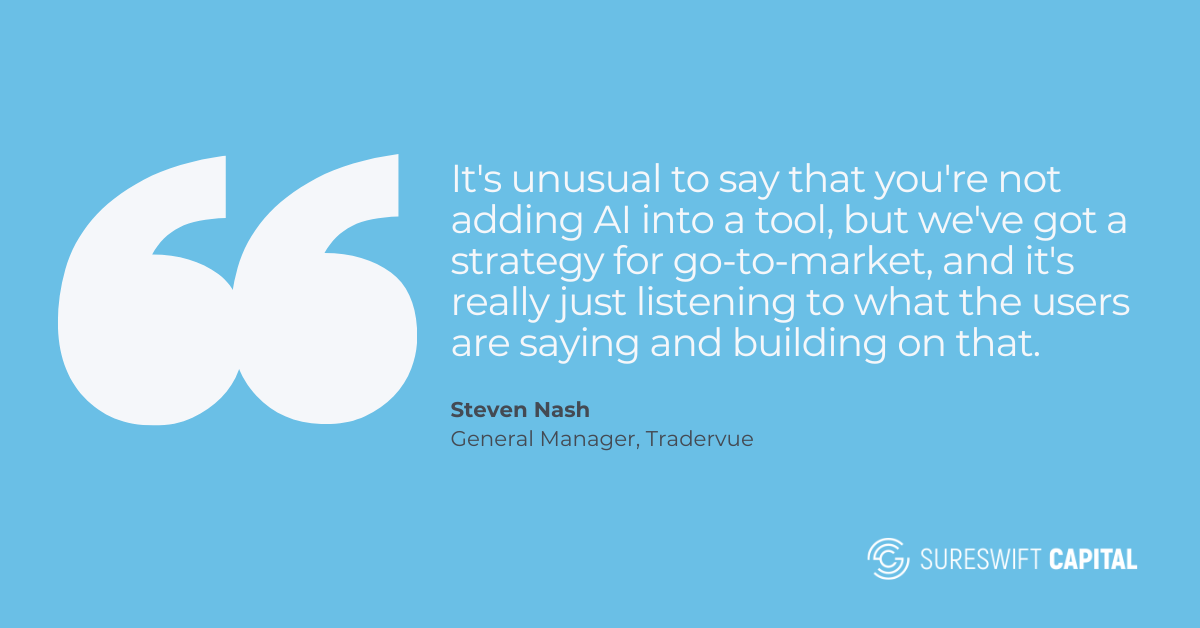
This philosophy extended to product design. While some competitors built feature-rich platforms aimed at advanced or niche traders, Tradervue deliberately kept things straightforward.
"The main thing is keeping things accessible and simple for the average trader," Nash explains. "90% of what traders want is usually a really attainable thing. If you start adding in a lot of requests, the tool becomes much more complex. People basically fall off during onboarding."
The result is a platform that looks deceptively basic by design.
"That's honestly on purpose," Nash admits. "There's a ton of logic in terms of how we import and group things, but we try to make it as simple as possible, so all (users) need to do is come in, import, and click around."
Understanding the users

Tradervue's target user isn't a beginner trader. They've moved past the experimental phase of trading and are treating it more seriously, often having already lost money and deciding to approach trading with more discipline.
"They've probably lost a little bit, then thought, 'I'm going to take this a little more seriously.' They've usually deposited $25,000 to $30,000 so they can get around the PDT restriction for trading. And then they started to treat it more like an actual job than just a hobby."
At $49.95 per month, Tradervue isn't for casual hobbyists. It's for people who have crossed a threshold and are committed to improving. They recognize that tracking and analyzing their performance is worth the investment.
A smaller segment of users are already profitable professionals who have been tracking their trades manually — often in spreadsheets or even handwritten notebooks dating back to the early 2000s. For them, Tradervue isn't about learning what works; it's about saving time.
"They're really religious about it," Nash says. "They do that every day for every trade they take. For them, Tradervue can save maybe an hour or two a week."
The feedback loop: Quarterly roadmaps and continuous listening
Tradervue's approach to product development is rooted in structured feedback. Every quarter, the team sends out email surveys to three distinct user segments: active paying users, churned users, and people who signed up but never started a trial.
Each group gets tailored questions. For example, for users who never started a trial: Why didn't you sign up? For churned users: You understood the product; what made you leave? For active users: What's working, and what could be better?
This feedback informs three-month roadmaps. The team sticks to the plan at a high level but remains flexible for quick fixes. "If a number of customers reach out because something is, in their opinion, broken or not working, and we identify it as a quick fix — maybe a couple of days of a senior developer — then we fit that into the roadmap," Nash explains.
Importantly, they've been fortunate enough to avoid emergencies or urgent changes. But the quarterly cadence ensures that user needs are never more than a few months away from being addressed.
The cost of experimentation: When to stop
By mid-2025, Tradervue had found what worked: SEO and a focused customer segment. But instead of doubling down, the team started experimenting with new marketing channels.
"(It) spread us a little thin," Nash admits. "And we kind of lost a bit of focus."
The lesson? Experimentation is valuable for discovery, but it becomes a liability once you've found what works. For a small team with limited resources, scattering efforts across multiple channels diluted results.
"We're a small team. We get really good results for what we're doing," Nash reflects. "So let's focus on what's working and just double down on that."
While innovation has its place and purpose, this is about recognizing when experimentation has served its purpose. The goal now is to execute relentlessly on what's proven, rather than chasing marginal gains in unknown areas.
Looking ahead: Engagement over acquisition

Continuing through 2026, Tradervue's priorities are shifting. While acquisition remains important, the team is now focused on user engagement within the app.
"Our churn is stable. We're happy with that," Nash says. "But we really want to get users coming back more, using the app and all its features more."
He says it's not that the features aren't useful, it's that users don't always see their value or know how to integrate them into their workflow.
"There's a large segment of users who don't use all of the core features, or they don't use them daily," Nash explains. "We think it's because it's not something that's been shown to them — how powerful it can be to improve their trading."
The solution is education, but not in the traditional sense. The team tested live webinars before and found low engagement. "People usually work full-time jobs, then they're trading on the side, and trading is nearly a full-time job in itself with the review," Nash explains, which is likely why they don't have the time or energy.
So, the team is focusing on in-app education: guided onboarding, tooltips, demos, and animations that teach users while they work. The goal is to make learning seamless and embedded in the live experience rather than requiring extra time outside of it.
What other companies can learn
Tradervue's story is about a series of intentional choices that compounded over time. Here are the biggest takeaways for founders and investors, even those outside of Tradervue’s market:
Test broadly before committing. Tradervue spent about six months experimenting across channels before focusing on what worked. This prevented them from committing prematurely to strategies that might not have delivered.
Treat simplicity as a competitive advantage. By keeping the interface approachable, Tradervue reduced onboarding hassle and made the product accessible to the average trader — not just power users.
Listen to users, not trends. While competitors rushed to add AI features, Tradervue surveyed its users and learned that it just wasn't a priority. Ignoring hype saved them time and money, and kept the product aligned with actual user needs.
Know when to stop experimenting. Experimentation helps with uncovering and understanding, but only until you find what's working. For small teams, focus is everything.
Segment your feedback. By surveying paying users, churned users, and signups separately, the team gained specific insights into different parts of the funnel, which helped them address the right problems with the right solutions.
Offer frictionless education. Users don't always have time for webinars or training sessions, live or recorded. Embedding education into the product experience makes a tool more likely to be used.
Complexity and constant pivoting are often rewarded, but Tradervue's success comes from constraint, clarity, and knowing when to say no. Its journey through 2025 was about catching up, testing systematically, finding what worked, and then having the discipline to stick with it.
Now, for Nash and his team, the biggest lesson for 2026 is incredibly simple: to focus on and stick to what's working.
Check out SureSwift's blog for more business tips, or you can learn more about Tradervue or try it free for 7 days.

Related articles
.png)

OpenClaw, AI Agents, and the Future of SaaS Work
AI agents are starting to move from side experiments into the flow of real work. OpenClaw shows what that shift can look like for SaaS founders and their teams: where agents can help, how to choose the right use cases, and why guardrails matter.