Conversion rate optimization for SaaS: What actually works in 2026 (and beyond)
.jpg)
The steps to maximize SaaS conversion used to be simple: drive more traffic, get more trials, and grow revenue. And for a long time, it worked. Now it doesn't — at least not the way it used to.
According to Benchmarkit, the median new customer acquisition cost (CAC) ratio increased 14% in 2024 alone — meaning the typical SaaS company now spends $2.00 to acquire every $1.00 of new annual recurring revenue (ARR). Bottom-quartile companies spend $2.82.
At the same time, the traffic environment is shifting in ways that weren't on most operators' radar just a couple of years ago. Google AI Overviews now appear in approximately 13% of all search queries globally, and when they do, position-one organic click-through rates drop by about 18%.
Meanwhile, generative AI tools like ChatGPT are sending referral traffic that converts at higher rates than traditional organic.
A 12-month analysis across 94 ecommerce sites found ChatGPT referral traffic converted 31% higher than non-branded organic search, and a case study measured ChatGPT converting at 15.9% versus 1.76% for Google organic — by the time those visitors click through, they've already worked through the consideration stage inside the AI platform.
The old playbook assumed volume. The new reality rewards efficiency.
That's what modern conversion rate optimization (CRO) is actually about. Not just button colors and landing page A/B tests — though those still matter — but the full arc of how the right users find you, understand what you offer, sign up, get to value, and decide to stay.
Table of Contents
- What modern CRO actually looks like
- The biggest CRO opportunities in SaaS
- How AI is changing CRO
- Common CRO mistakes to avoid
- A portfolio example: What Storemapper learned about signup quality
- Tools that support better CRO decisions
- Helping the right users succeed faster
What modern CRO actually looks like
The phrase "conversion rate optimization" still conjures images of heatmaps, headline tests, and someone arguing about whether the CTA button should be green or orange. Sure, those tactical exercises can generate incremental wins. But in 2026, they're table stakes at best and a distraction at worst.
Modern CRO is really about customer understanding. It starts with honest questions: why do the right users convert, and why do the wrong ones either bounce or churn shortly after?
The answer almost never lives in a single page element. It's found in:
- a gap between what you think your product does and what users actually believe it does when they first encounter it
- frictional moments where something is confusing, slow, or uncertain enough that a user decides the effort isn't worthwhile
- trust — does your product look, feel, and behave like something built by people who understand a user's problem?
User intent is the missing ingredient in most CRO programs. Two visitors can land on the same pricing page and be completely different buyers — one is casually browsing, one is ready to buy by end of week.
Treating them identically is a missed opportunity. Understanding the intent behind different traffic sources, search queries, and referral paths is increasingly the competitive edge in SaaS conversion.
This also means that CRO can't live in the marketing team alone. The best conversion programs loop in product, customer success, and even sales, because the leakiest parts of most funnels are things like the signup flow, the first-run experience, and the moment a user either finds value or silently disappears.
The biggest CRO opportunities in SaaS
When it comes to improving CRO for your SaaS, here are the focus areas where you'll find wins:
Homepage and landing pages
Your homepage has one job: make the right person immediately understand this product is for them, not for everyone. And not in 12 months after they've watched a webinar series. Right now, in the first 10 seconds.
That requires a value proposition specific enough to resonate and confident enough to alienate people who aren't your customer. "Powerful, flexible software for teams" is not a value proposition. "Add a branded store locator to your Shopify site in minutes" is.
Beyond messaging clarity, the biggest homepage conversion killers are:
- Slow load times. Ecommerce sites loading in one second were found to convert 2.5 times more than those loading in five seconds, with a steeper gap on mobile, where most SaaS evaluation happens
- Weak or absent trust signals, like customer logos, review counts, and security badges, that reduce the uncertainty a new visitor brings to the page
- Misaligned content — pages built around what you want to say rather than what a visitor at that stage of evaluation needs to hear
That user experience matters more than ever, given how AI search is changing who lands on your pages.
Visitors arriving from AI-assisted search have often already consumed a summary of your category and don't need a repeat. Instead, they're looking for specifics that confirm or deny whether your product fits their use case. Pages that lead with generic category language waste that intent.
Pricing and signup flows
Pricing pages are one of the highest-leverage CRO surfaces in any SaaS product — and one of the most consistently over-engineered.
Decision fatigue is real. When a visitor has to evaluate four tiers with feature matrices, calculate which plan fits their team size, and figure out what "unlimited" actually means in a given context, the cognitive load becomes a reason not to decide.
Simplifying pricing structure, even if it means leaving some revenue optionality on the table, can increase conversion more than any copy or design change.
The signup flow itself is the other major opportunity many teams underinvest in. All fields you add to a signup form are a conversion tax. Every confirmation step, every required profile completion before the user can try the product — each one costs you signups. Remember, the job of the signup flow is to create the shortest possible path from "I want to try this" to "I'm inside the product."
Opt-out trials (credit card required) convert at significantly higher rates — about 49–60% compared to about 18–25% for opt-in trials — but they also reduce the pool of people who start a trial in the first place. Neither model is universally right.
What matters is that you understand the tradeoffs for your specific product and pricing tier, and that you're measuring the full-funnel from visit to activation, not just signup volume.
Product experience and retention
This is where most traditional CRO programs stop, but it's also where most of the real opportunity lies.
Research shows that roughly 75% of new SaaS users abandon a product during onboarding, often within the first week. A huge predictor of whether someone stays is if they reach a meaningful "aha moment" — a specific in-product experience where the value of the tool becomes tangible — early in the trial.
Users who activate within the first three days of signup are 90% more likely to continue using the product.
Cutting time-to-value is one of the highest-leverage levers available to most SaaS operators. A 2024 study found that reducing time-to-value by 20% correlated with an 18% lift in ARR growth for mid-market SaaS companies. That means the faster you can get new users to the moment where your product earns its keep, the more of them will stick around to pay for it.
This reframes onboarding not as a customer support function but as a core conversion surface. Personalized onboarding flows outperform static ones by about 35–50% in activation metrics. Interactive product walkthroughs produce significantly better retention than passive video tours. Even small interventions, like a well-timed in-app prompt or a single email triggered by inactivity, can materially move activation rates.
The CRO insight here is that retention and conversion are not separate problems. A high trial-to-paid rate built on a bad onboarding experience is just a delayed churn problem. The teams winning in SaaS right now are treating the full journey from first visit to second contract renewal as a single optimization surface.
How AI is changing CRO

AI is reshaping conversion work in a few distinct ways:
On the analytics side, AI-assisted tools are accelerating the speed at which teams can identify patterns in user behaviour.
Session recording platforms can surface rage-click clusters automatically — tools like FullStory auto-tag sessions with frustration signals without manual configuration. Product analytics tools can flag cohorts of users who are failing to activate without a human analyst building every query.
This is real, practical value, as it lowers the cost of knowing what's broken.
On the personalization side, AI is making it viable for smaller teams to run personalized onboarding flows, messaging sequences, and in-app experiences that would have required much larger engineering investment just a few years ago.
Capabilities for dynamic content, behavioural triggers, and adaptive messaging are now accessible at the tool level rather than requiring custom development.
On the search and traffic side, the dynamics are more complicated and the implications for SaaS operators more consequential.
AI overviews are absorbing organic click share on informational queries. But the flip side is that traffic arriving from generative AI platforms — like users who found your product through a ChatGPT recommendation or a Perplexity summary — shows meaningfully higher conversion intent.
A study by WebFX found that in SaaS, AI-referred visitors converted at rates exceeding 50%, compared to 20–30% for standard organic search. The volume is still much smaller than traditional search, but the intent signal is significantly stronger.
This means the quality of your traffic increasingly matters more than the volume of it. A funnel optimized for high-intent visitors — with landing pages that speak to a specific use case, onboarding flows calibrated for buyers who already understand the category, and messaging that skips the educational basics and gets straight to differentiation — will outperform a funnel optimized for raw traffic volume.
But remember, AI should support customer understanding, not replace it. No AI tool knows why your specific customers choose you over a competitor. That knowledge lives in customer interviews, support tickets, and churn surveys. Crucially, CRM "closed-lost" reasons have been found wrong 85% of the time when cross-referenced with actual buyer interviews, suggesting most teams are operating on bad assumptions about why they win and lose.
Common CRO mistakes to avoid
If you're working through CRO for your SaaS, a few patterns reliably lead operators astray:
1. Optimizing for trial volume instead of trial quality. A signup from someone who vaguely matches your use case isn't the same as a signup from someone who has the problem you solve, has tried alternatives, and is actively evaluating.
Funnel metrics that don't segment by intent or fit will always point toward changes that grow volume at the expense of quality.
2. Overcomplicating onboarding. The average SaaS onboarding checklist completion rate is around 19%. Three-step product tours complete at 72%; seven-step tours complete at just 16%.
So, every additional step you require before a user can experience value is a bet that your product is interesting enough to earn that patience. Most products aren't.
3. Ignoring retention in a conversation about conversion. If your trial-to-paid conversion rate is 20% but you're churning 8% of customers per month, you don't have a conversion success — you have a leaky bucket.
Sustainable SaaS growth means both converting the right users and keeping them. The two problems are inseparable.
4. Copying competitor tactics without understanding your customer. If a competitor moves to a freemium model or rewrites their pricing page, it's tempting to assume they've figured something out that you should replicate. But tactics work in context.
What converts strongly for a well-funded competitor with solid brand recognition may actively hurt a smaller product that depends on trial urgency to drive decisions.
5. Chasing "growth hacks" instead of durable improvements. The history of SaaS marketing is littered with tactics that worked brilliantly for six months and then stopped — either because the channel saturated, competitors caught on, or the underlying behaviour changed.
Sustainable conversion improvement comes from understanding your customer more deeply over time, not from finding clever tricks.
A portfolio example: What Storemapper learned about signup quality
One of the clearest illustrations of modern CRO thinking comes from Storemapper, a customizable store locator in SureSwift's portfolio.
In Q1 2026, Storemapper's marketing manager, Julia Fertig, led a rigorous cross-functional investigation into a troubling pattern: trial signups were falling sharply. The instinctive reaction would have been to start testing landing page copy or tweaking the signup flow, but the data told a very different story.
The numbers looked alarming on the surface. Trials were down about 40% year-over-year across both the website and Shopify channels. On Shopify specifically, visitors had dropped 52.6%, and trials were down 44.1%.
For most businesses, data like that would trigger a full CRO pivot: rewrite the homepage, simplify the pricing page, cut friction from the signup form.
But Julia's team pulled the full-funnel picture first, and what they found flipped the diagnosis entirely:
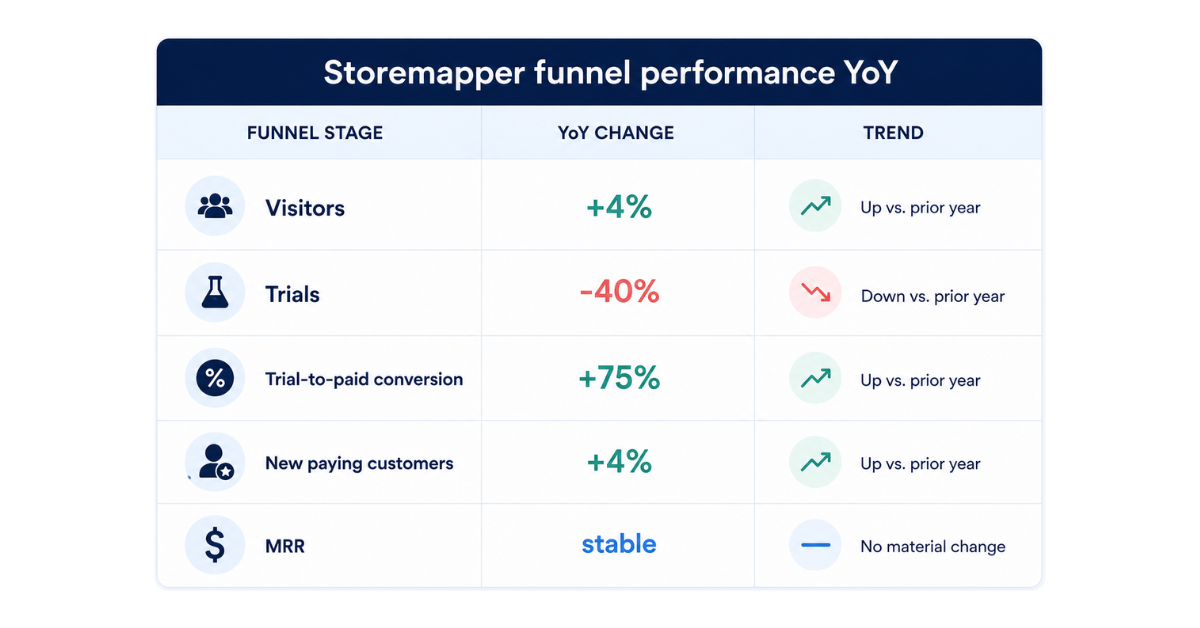
Traffic had actually grown slightly. New paying customers were up. MRR was holding. And trial-to-paid conversion had improved by 75%. So the funnel itself wasn't broken, but the top of the funnel was receiving far fewer high-intent visitors than before.
The investigation traced the issue upstream to organic search. Google Search Console data showed organic clicks down 35%, impressions down 15%, and CTR down 22% — despite average ranking positions actually improving by 40%. That paradox of ranking better but getting fewer clicks is a classic case of AI overviews and enhanced SERP features absorbing clicks before they reach the site.
Critically, the traffic losses weren't evenly distributed. The pages hit hardest were the home, pricing, and demo pages, and branded searches for "storemapper," precisely the pages visited by buyers who are actively evaluating and ready to make a decision.
High-traffic blog content (like posts about the Google Maps API) was pulling volume but generating much lower purchase intent. The team had reach. What they'd lost was evaluation-stage visibility — the traffic that actually converts.
As Fertig's analysis concluded, the team didn't lose reach; they lost traffic in the evaluation stage.
And the broader lesson is one every SaaS operator should understand. A significant decline in trial volume with stable revenue and improving conversion is a distribution and acquisition problem, not a conversion crisis. It's crucial to take time to analyze all available data before forming conclusions, as Fertig's team did.
The 30-day action plan that followed had the team focused on recovering visibility for high-intent pages, creating comparison content that speaks to buyers in decision mode, bridging blog content to product pages with stronger CTAs, and refreshing the Shopify listing to target a clearer buyer profile.
The Storemapper investigation also surfaced an important point about AI's role: it supported rather than drove the process. AI tools were used as an analytical accelerator throughout — handling temporal comparisons, cross-referencing patterns across website, Shopify, and SEO data, and flagging anomalies in raw exports. But all conclusions were manually validated with human judgment.
Tools that support better CRO decisions
Good CRO work is tool-supported, but it's never tool-driven. Here's what actually earns its place in a modern SaaS CRO stack:
Behaviour analytics (like Hotjar, Microsoft Clarity, and FullStory) give you heatmaps, session recordings, and scroll depth data that show where users are paying attention and where they're abandoning. Essential for diagnosing friction on landing pages and in signup flows.
Product analytics (like Amplitude, Mixpanel, and PostHog) let you track the in-product behaviours that predict retention — like feature adoption, time-to-first-value, and activation milestones. This is the conversion insight that matters most.
Experimentation platforms (like Statsig, Optimizely, and VWO) allow you to run structured A/B tests and validate hypotheses before committing to changes. Even small SaaS products can run meaningful experiments if they're disciplined about what they're testing and why.
Onboarding tools (like Appcues, Userpilot, and Intercom) support in-app product tours, tooltips, checklists, and lifecycle messaging. These levers are directly tied to activation rates and early retention.
AI-assisted analytics, which many of the above platforms now include, can surface patterns, like unusual drop-off points, cohort anomalies, and engagement gaps, that would take a human analyst days to find manually. The value is in diagnosis speed.
The most important thing any of these tools can do is point you toward a question worth asking. But they can't tell you why users behave the way they do. That still requires talking to customers, reading support tickets, and building enough institutional knowledge of your users that the data starts to mean something.
Helping the right users succeed faster

There's a version of CRO that's fundamentally adversarial — the dark patterns, artificial urgency, and pricing pages designed to obscure rather than communicate. It can move metrics in the short term. It's also a reliable way to increase your churn rate, your refund requests, and the number of negative reviews you collect in year two.
The version of CRO that actually builds durable SaaS businesses is simpler in principle, though harder in practice: figure out exactly who benefits from your product, make it as easy as possible for them to find you, understand your value proposition clearly, get started quickly, and experience a meaningful win before their trial ends.
That means obsessing over message clarity before you obsess over button design. It means treating onboarding as a first-class product investment rather than an afterthought. It means understanding that a 500-user trial cohort with 30% conversion is almost always better than a 2,000-user cohort with 5% conversion — for revenue, yes, but also for product feedback quality, customer success load, and long-term retention rates.
As acquisition costs continue to rise and search traffic becomes more competitive and less predictable, the SaaS businesses that win will be those that get more value out of every visitor, trial, and conversation. That's the promise of modern CRO, and it's available to any operator willing to do the deeper, ongoing work of genuinely understanding their customer.
SureSwift Capital acquires, operates, and grows B2B SaaS businesses. Learn more about our portfolio, explore whether selling your SaaS might be the right move, or get in touch.

Related articles
.png)

OpenClaw, AI Agents, and the Future of SaaS Work
AI agents are starting to move from side experiments into the flow of real work. OpenClaw shows what that shift can look like for SaaS founders and their teams: where agents can help, how to choose the right use cases, and why guardrails matter.