
When Automation Breaks, Support is the Product: Docparser on Delivering the “Best Customer Support”
.png)
When you think about automation tools like Docparser and Mailparser, it’s easy to focus on what they do: extract data and streamline workflows to reduce manual work.
But what happens when those workflows break?
In parsing products, that’s just inevitable. Documents change, formats shift, and inputs differ. And when they do, entire downstream processes can stop.
That’s why support isn’t a side function. It's a core part of the product experience.
This is the context behind Docparser’s recent recognition for Best Customer Support from Software Advice. The award reflects how the shared team behind both products operates each day: with consistency, technical depth, and a focus on making sure workflows don’t just run, but keep working well.
And for Quinn Mooney, Customer Happiness Manager across both products, the recognition reflects something deeper than a single milestone.
“It means a lot to the team and me. We’ve put a huge amount of care into how we support our customers … What stands out most is hearing how our work improves someone’s day-to-day."

Table of Contents
- Why parsing support is inherently complex
- How the team handles these issues
- What users often underestimate
- The tradeoff behind great support
- Why this approach works
- Takeaways for founders and operators
Why parsing support is inherently complex
Unlike more predictable SaaS tools, parsing sits at the intersection of messy, real-world data and structured automation. Every document is different. Layouts morph. Scans vary in quality. OCR introduces another layer of uncertainty.
As Mooney explains, the challenge is not only technical but contextual, too, with a lot of variability.
“With parsing, you’re not just dealing with a single, predictable interface; you’re working with documents that can vary in format, quality, and structure, especially when OCR is involved.”
The team has to support how that large, varied interface fits into a much bigger workflow. That’s where complexity compounds.
A small tweak, like a new column in an invoice, a slightly lower-quality scan, or a shifted layout, can suddenly break extraction. From a user’s perspective, nothing major has changed. But underneath, those small inconsistencies can break automation.
“Most problems we end up solving are minor issues with formatting," Mooney confirms. "A company might have a document with one kind of layout, they update it, and that breaks something.”
Those issues are difficult to diagnose because the root cause isn’t always obvious. The document looks the same, but the structure isn’t. And because Docparser and Mailparser often sit inside larger workflows, the impact doesn’t stay contained.
“A small effect downstream,” be it a missed field or partially extracted value, he says, can ripple into other systems like accounting tools, CRMs, or reporting pipelines.
That quickly turns a minor parsing issue into a broader operational problem.
How the team handles these issues
Most customers don’t come in with “parsing problems.” They come in with business problems that carry urgency:
- “Our invoices stopped syncing.”
- “This field isn’t showing up anymore.”
- “Our workflow is breaking halfway through.”
When these things happen, the team’s approach is methodical and deeply tied to understanding the customer’s business.
“There's a lot of communication. We need to understand their whole process,” Mooney says. “It’s a very technical role.”
That starts with investigation.
“We’ll usually go in, look at the document itself and the differences between the data within it and coming out of it,” he explains. From there, the team reviews parsing rules, checks webhook logs, and traces the problem across the workflow.
But resolving the issue is only part of the job: as Mooney notes, there's an "educational role with it" as well. Sometimes the team implements fixes directly. Other times, they guide customers to understand how to maintain and improve their own setup going forward.
A common (and complex) example
One of the most involved scenarios the team encounters involves enterprise customers processing documents of different formats, like invoices or emails, from hundreds — or even thousands — of their own clients.
In these cases, “They build very, very complex setups, involving single parsers passing lots and lots of different rules from different layouts,” Mooney explains.
While one parser designed to handle multiple document types consistently may sound ideal, it's actually where things get fragile.
The challenge comes when a change or edge case in one document type starts to affect how others are parsed, especially when there are shared rules or dependencies.
“There are a lot of things where you pull a thread, and something else comes loose,” he observes. Fixing one issue can unintentionally break another, especially when rules overlap across document types.
When that happens, the team takes a careful, methodical approach, isolating specific document types, testing different configurations, and working closely with the customer to understand their data.
So, the team takes a careful, methodical approach:
- Isolate specific document types
- Test different configurations
- Work closely with the customer to understand edge cases and data nuances
And through that approach, resolving these cases requires careful iteration: identifying the exact failure point, validating assumptions, and making changes.
This process helps Mooney's team refine a setup to fix the problem and handle variation “in a reliable way that doesn’t break anything else,” all while maintaining consistent output.
What users often underestimate
One of the most consistent patterns Mooney sees is how users think about automation. “They usually underestimate the whole workflow and the bigger picture,” he says.
Customers often come in with a clear goal, like extracting invoice data and sending it to a spreadsheet, but haven’t fully mapped out the full workflow around it.
“They haven’t given a lot of thought to how they’re going to get documents to us, how they’re going to send them out, what those extra steps involve.”
That’s where support becomes consultative.
Mooney's team not only troubleshoots parsing rules but also helps customers think through the entire system, from input to output. This creates a broader perspective that's often the difference between a setup that works temporarily and one that’s reliable long-term.
The tradeoff behind great support
But maintaining high-quality support in a complex product comes with tradeoffs.
The most important one: speed versus accuracy. This might be the opposite of many support environments, but for Mooney and his team, it's paramount.
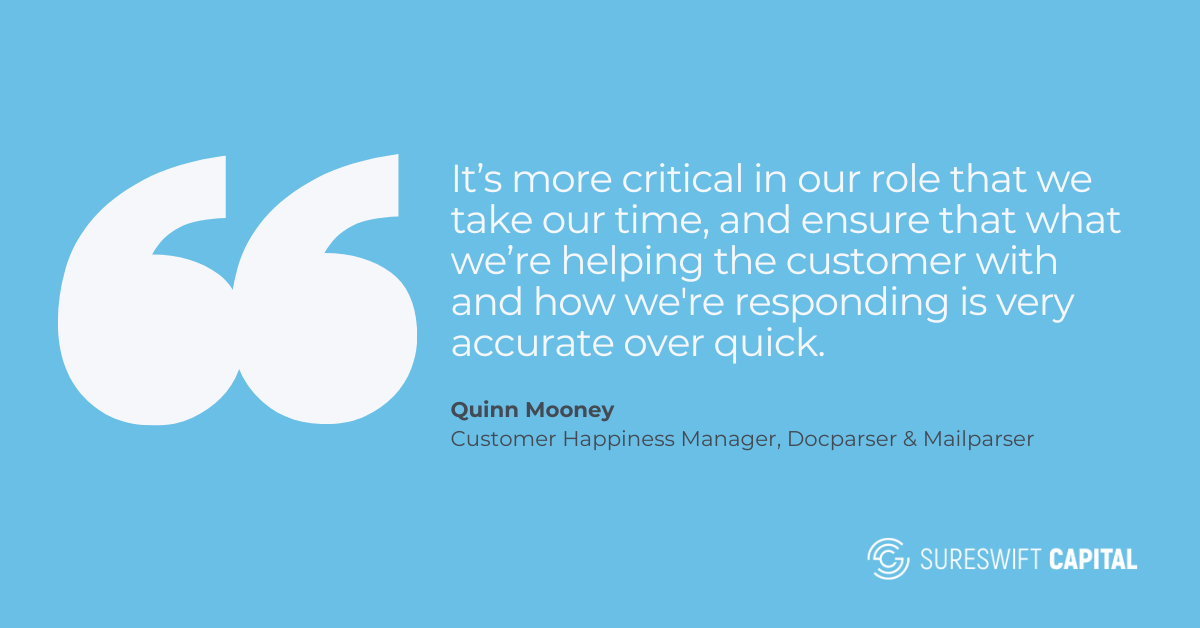
Otherwise, there's too much at risk as the stakes are simply too high: “If something gets through that's incorrect, it could mean an entire company’s service is down.”
That’s why the team prioritizes thorough investigation and reliable fixes over fast responses. Instead of rushing a quick fix, they take the time to fully understand the issue, test solutions, and ensure they hold up.
It may take longer in the moment, but it reduces repeat issues, builds trust, and lowers overall support demand long-term.
At the same time, there’s a constant balance between guiding customers and stepping in directly.
“Sometimes we’ll suggest to the user what they can do; other times we’ll go in and make the change ourselves,” Mooney explains.
The chosen approach depends on the complexity of the issue and the customer’s comfort level. If the issue is complex or urgent, the team steps in directly. Otherwise, if a customer is comfortable, they’re guided through the process step-by-step.
Why this approach works

When products become mission-critical, like Docparser and Mailparser, support becomes inseparable from the product itself. That status takes issue resolution to a higher level, shaping whether customers can rely on the product at all.
That means when workflows break, response quality determines how quickly customers recover and whether they trust the system moving forward.
That’s why, in Mooney's view, support needs to be:
- Proactive, not reactive
- Deeply informed, not surface-level
- Focused on long-term reliability, not quick fixes
“I think one of the main things is probably how consistent we are,” Mooney reflects. The team meets regularly, shares knowledge, and focuses on getting to accurate, reliable answers rather than rushing through tickets.
That consistency extends to how they work with (and keep) customers in the long term.
“We establish a relationship with them. I’ve had a lot of customers who ask for a specific team member by name.”
That level of trust isn’t built through a single support interaction. It comes from repeated, high-quality problem-solving over time.
The Parser's recent recognition didn't come from a one-off achievement but the result of this consistent execution: a team that values problem-solving, shares knowledge internally, and takes pride in improving customers’ day-to-day work.
Takeaways for founders and operators
For anyone leading teams that build complex, automation-driven products, Mooney's experience highlights a few key lessons:
1. Operate with support integral to the product experience, not functioning separately. When workflows break, quality support defines the experience and stays core to how the product works in practice. This will be especially key as the product grows.
2. Hire for problem-solving ability, not just communication. In complex systems like parsing, curiosity and persistence matter as much as clarity. When recruiting for his team, Mooney looks for people who "enjoy puzzles and get a thrill out of problem solving.”
3. Optimize for reliability over speed. Quick fixes don’t build trust — durable solutions do. Taking time to get things right leads to more stable systems and fewer issues over time.
Great support is often quiet, consistent, behind-the-scenes work: understanding detailed workflows, testing edge cases, and tirelessly making small improvements that prevent bigger issues later.
And Docparser’s recognition for Best Customer Support is a reflection of that. The team knows that when failure can stop a business process, great support makes the difference between a tool that just works and one that users can rely on long-term.

Related articles
.png)
.png)
.png)
Expand Your Audience by Niching Down: Lessons from MeetEdgar GM Lacey Sheardown
Niching down can feel limiting, especially when competitors keep adding features. MeetEdgar’s GM Lacey Sheardown explains how refocusing on their core audience led to clearer product decisions and stronger growth.
